Multi-agent execution
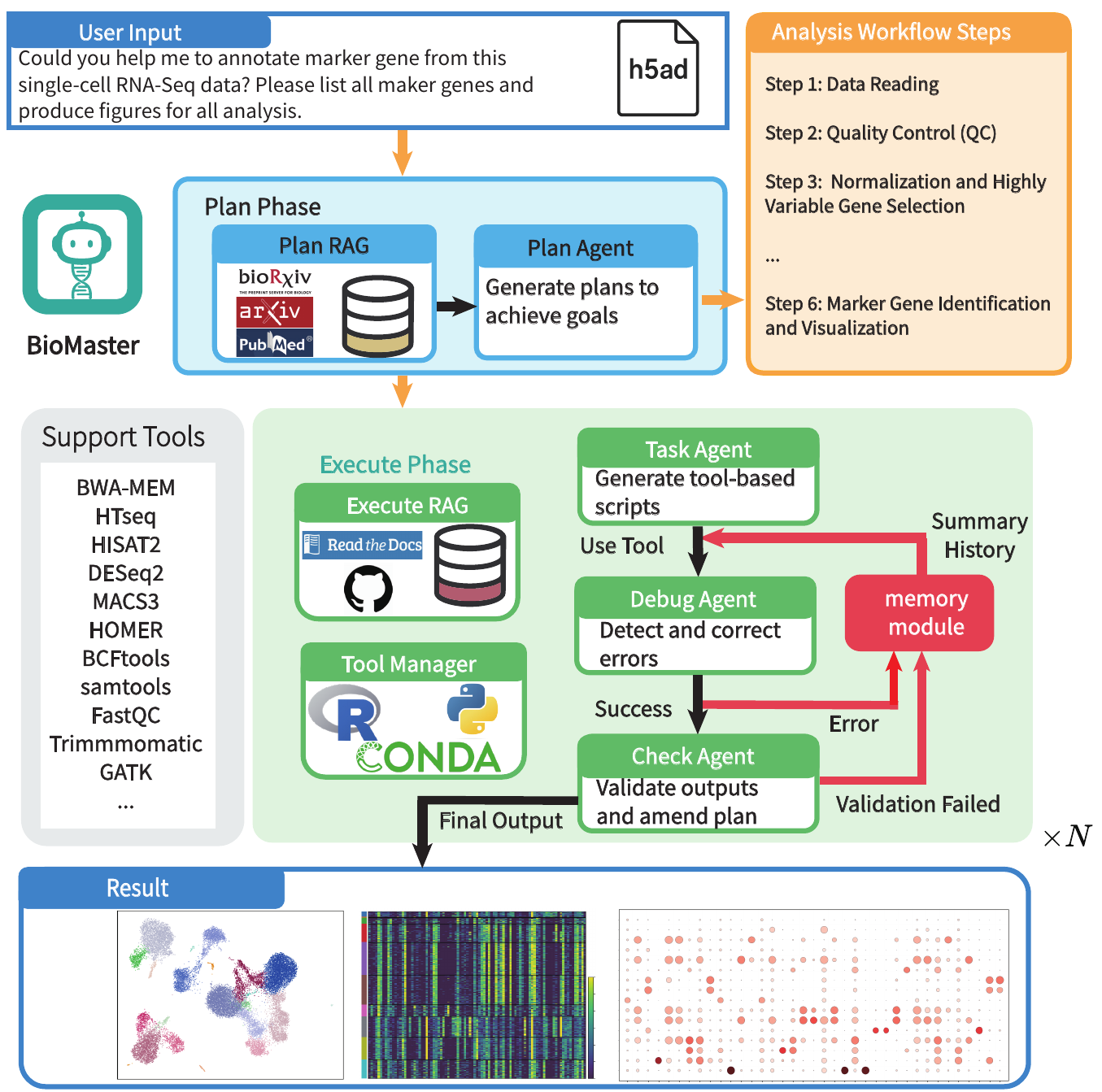
Four role-specific agents divide planning, command generation, debugging, and output validation.
Paper
A knowledge-guided multi-agent framework for planning, executing, debugging, and validating bioinformatics workflows.

Abstract
The growing volume and complexity of biological data have made bioinformatics workflows increasingly labor-intensive, error-prone, and difficult to scale. Large language model based agents offer potential for automation but often fail in complex, multi-step analyses due to limited robustness.
BioMaster integrates workflow planning, execution, error recovery, and output validation. Its dual retrieval-augmented design uses domain knowledge for tool selection, parameterization, and adaptation across tasks, while a dedicated Debug Agent supports real-time error detection and correction.
Across 49 bioinformatics tasks spanning 102 tools, BioMaster achieved a higher workflow completion rate than the baseline systems evaluated in the manuscript, particularly in complex, interdependent pipelines. The system supports proprietary and open-source language models for flexible deployment.
Four role-specific agents divide planning, command generation, debugging, and output validation.
Plan RAG retrieves workflow-level methodology, while Execute RAG retrieves command-level tool knowledge.
BioMaster is evaluated on 49 tasks across multiple omics modalities and 102 bioinformatics tools.
@article{su2026biomaster,
  title     = {BioMaster: Multi-agent system for automated bioinformatics analysis workflow},
  author    = {Su, Houcheng and Feng, Junning and Lu, Yawen and Xu, Yucheng and Yang, Jinming and Lu, Haojie and Yang, Jixin and Yang, Xu and Xie, Sirui and Long, Weicai and Wang, Chengrui and Hou, Yusen and Zhu, Tingyu and Zhang, Yanlin},
  journal   = {Patterns},
  year      = {2026},
  pages     = {101611},
  publisher = {Elsevier},
  doi       = {10.1016/j.patter.2026.101611}
}