Plan Agent
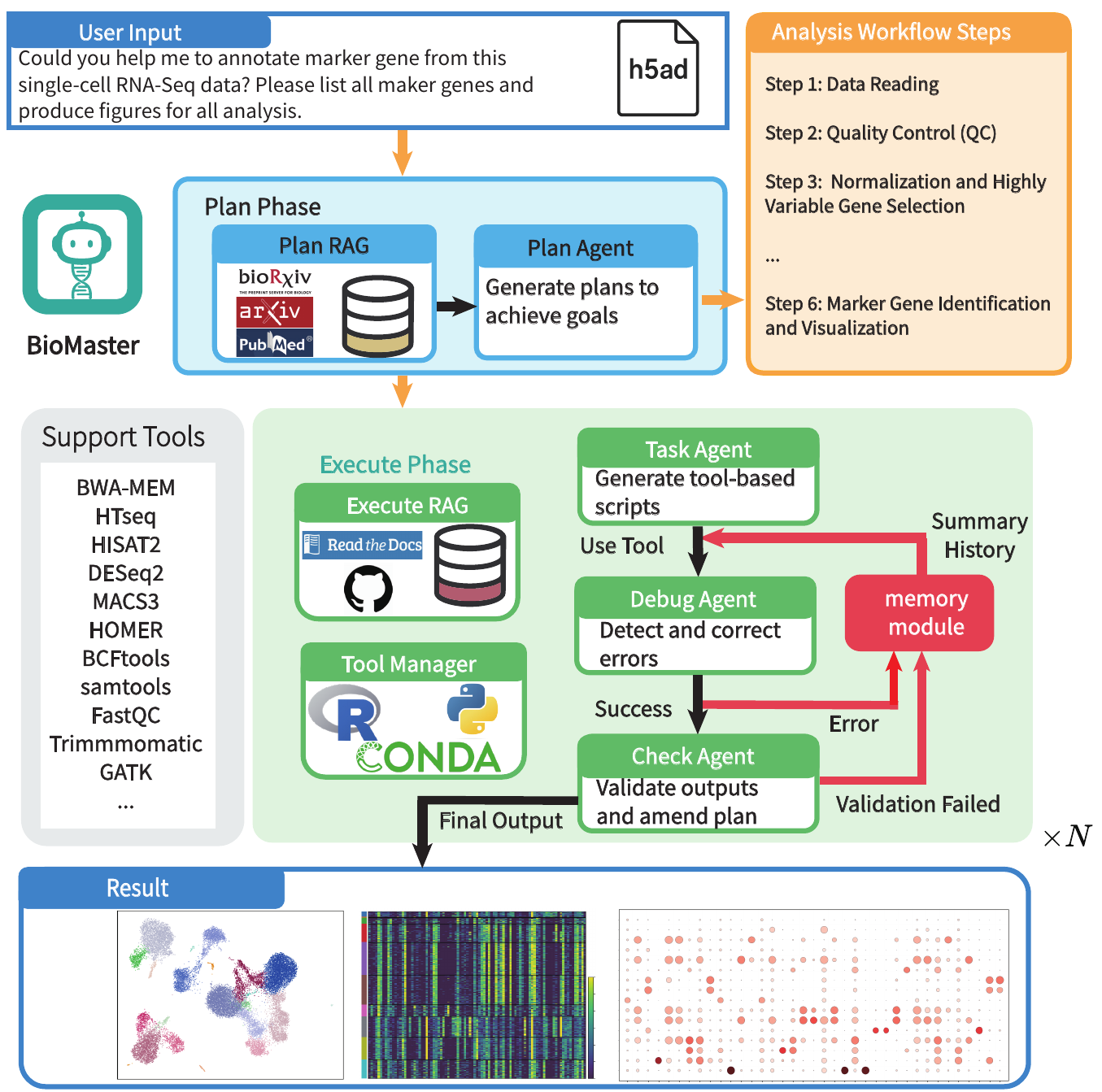
Retrieves workflow patterns from Plan RAG and creates a structured analysis plan.
Architecture
BioMaster decomposes a user objective into a checked workflow, then executes each step with retrieval support and bounded recovery.

Execution loop
Retrieves workflow patterns from Plan RAG and creates a structured analysis plan.
Uses Execute RAG to write tool-specific commands and scripts for the current step.
Parses runtime errors, retrieves troubleshooting knowledge, and retries corrected execution.
Verifies output existence, format, and completeness before downstream steps begin.
Dual retrieval
Stores high-level methodological knowledge such as workflow templates, analysis strategies, tool choices, input requirements, and expected outputs.
It is consulted during planning so the system can translate a natural language goal into a coherent multi-step workflow.
Stores low-level tool knowledge such as installation notes, command-line examples, parameters, configuration details, and troubleshooting hints.
It is consulted during execution and debugging so scripts are grounded in tool-specific evidence.
Implementation
Diagnostic history is summarized so later steps retain useful context without loading full logs.
A workflow does not proceed until the current step has passed execution and output checks.
BioMaster can run with proprietary or open-source LLM backbones through configuration.